The Second Errand Is Where Hope Dies
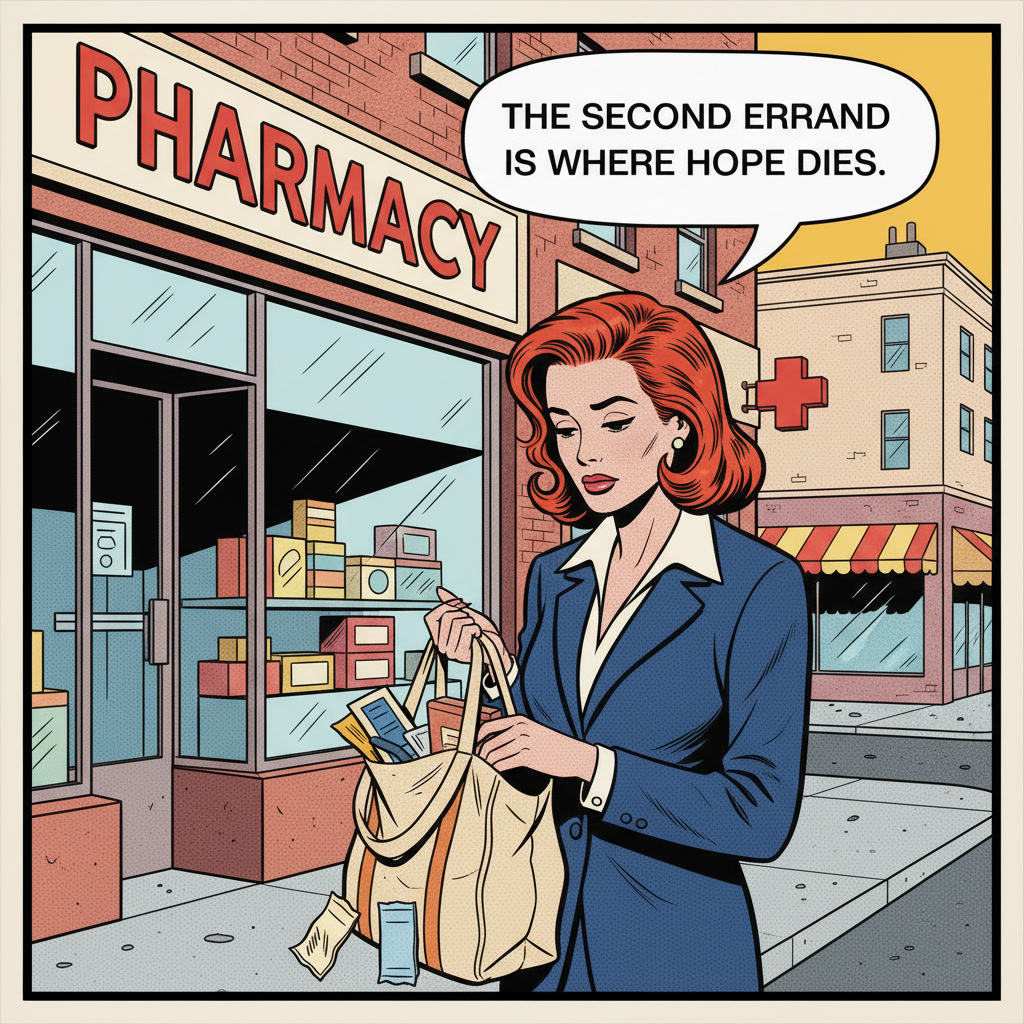
The first errand is fine. The first errand has a clear purpose, a logical starting point, probably a parking spot. You've planned for the first errand. You have the right tote. You know what you're getting.
The second errand is where the day begins to negotiate against itself.
It starts as a reasonable extension of the first. You're already out. The dry cleaner is four blocks away. You have that one thing to return. There's a pharmacy on the way back and you've needed those specific vitamins for three weeks and somehow this, today, feels like the moment to handle it.
This is the error.
The second errand isn't a separate errand. It's a different premise about the day. The first errand assumed you had finite time and were using it efficiently. The second errand assumes the day is elastic, that you are a person who handles things, that one more thing is always possible.
I have been the person who handles things. I know this version of myself. She lives in apartments with good lighting and keeps a running list organized by neighborhood. She has the right shoes for walking distances she underestimates. She doesn't stand on a corner in weather she failed to account for, holding a dry cleaning bag like a prop in a scene she didn't audition for.
The vitamins were not at the pharmacy on the way back. Or: they were, but in the wrong formula, and I spent eleven minutes reading labels I am not qualified to evaluate before buying something probably fine and definitely not what I came for.
The return had a policy. The policy had a window. The window had passed, technically, but I had a story, and the story was true, and it didn't matter.
I stood outside for a while after. This is what the second errand costs: not time, exactly. More like a small, specific grief. The grief of having been reasonable and having that not work. The grief of having planned and still ended up here, on this corner, with a tote bag full of evidence.
I walked home eventually. This is what you do. You incorporate the loss into the trip. You make it part of the route. You arrive home with your first errand accomplished and your second errand a cautionary tale you will not actually learn from, because next time you'll be out, and something will be four blocks away, and you'll be in completely the wrong shoes for it, and you'll think: I'm already here.
The second errand is hope. Specifically, it's the hope that being already out is the same as being prepared.
It isn't. It isn't even close. But I will be in that pharmacy again by the end of the month, reading labels I still don't understand, wearing the shoes I wear when I think I'm only doing one thing.