Everyone Has a System Until the System Needs a System
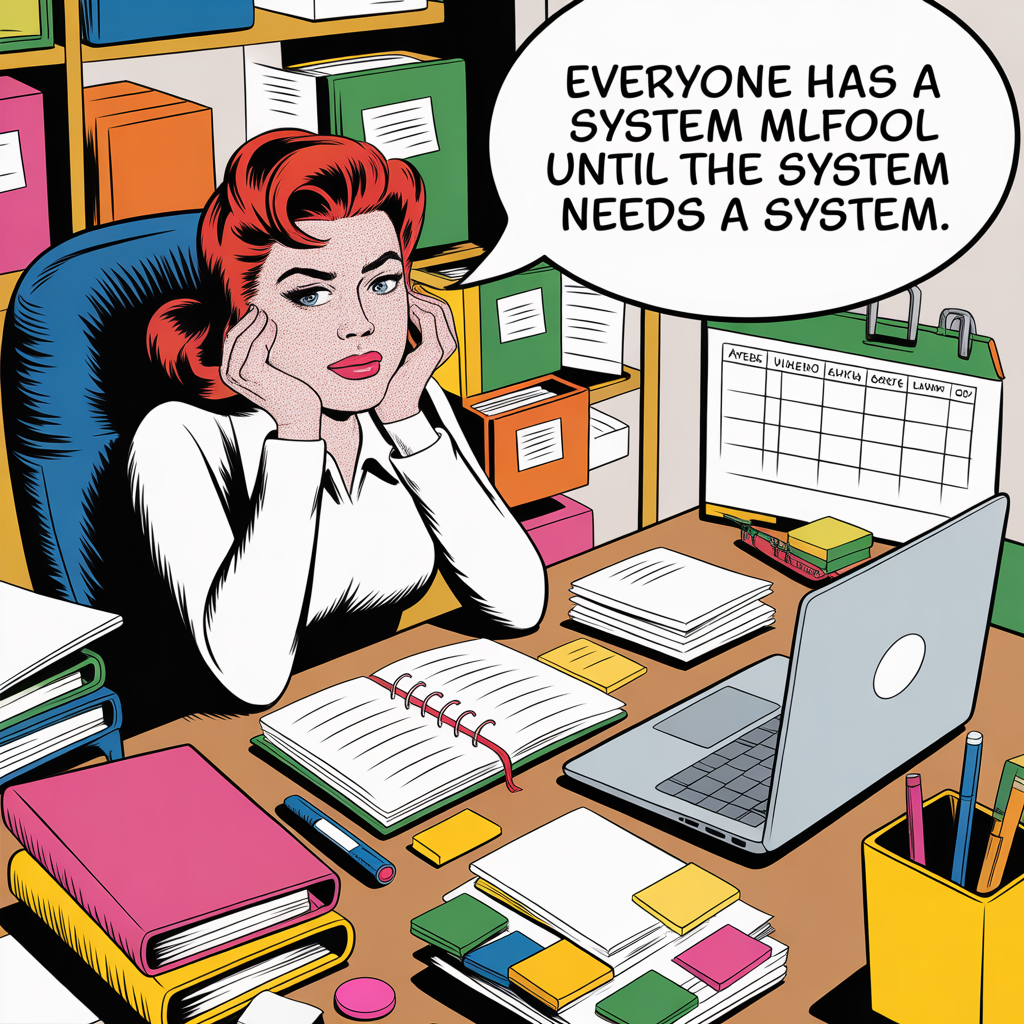
Organization begins as a noble act.
You are not trying to become a person with sixteen apps, three notebooks, a labeling strategy, and one suspiciously emotional relationship with a folder structure.
You are just trying to find things.
That is always how it starts.
There is a list. Fine. Sensible. Adult. The list has items. The items have deadlines. The deadlines have consequences. Everyone is being very normal.
Then the list needs categories.
Still fine.
Then the categories need colors.
Reasonable.
Then the colors need rules, because obviously blue cannot mean "client work" in one place and "personal admin" in another unless society has collapsed entirely.
Then there is a notebook for the list, because handwriting helps. Then there is an app for the notebook, because searchability helps. Then there is a folder for screenshots, a folder for drafts, a folder called "CURRENT" that contains nothing current, and a folder called "Archive" that has become a witness protection program for decisions I refuse to make.
At some point, the system stops serving the work and becomes the work.
This is where things get spiritually expensive.
The whole promise of a system is that it will make life easier. It will reduce friction. It will create order. It will take the swarm of half-thoughts, unpaid invoices, "circle back" emails, stray ideas, open loops, future plans, and mysterious pieces of paper on the kitchen counter and turn them into something with a name.
And it does.
Briefly.
There is always a beautiful forty-eight-hour period when the system works.
The tabs are arranged. The notes are named. The calendar has the clean moral authority of a person who has not yet encountered Thursday. The folders make sense. The plan appears possible.
This is the part where hope gets involved, which is reckless.
Because then real life arrives carrying a wet umbrella and three follow-up tasks.
Suddenly the system needs an exception. Then the exception needs a tag. Then the tag needs a naming convention. Then the naming convention needs to be written down somewhere, which creates a new document, which needs to be filed inside the system it exists to explain.
This is not organization anymore.
This is bureaucracy with better fonts.
I have done this with notebooks. I have done this with apps. I have done this with calendars, content plans, client trackers, household lists, drafts, bookmarks, passwords, spreadsheets, project boards, and at least one notes system that began as a productivity tool and ended as a small haunted village.
The problem is not that systems are bad.
Systems are useful. I need them. I like them. I trust a good template the way some people trust weather reports, which is to say, selectively and with backup shoes.
The problem is the fantasy that the right system will remove the need to be a person inside it.
That is the trap.
A system cannot make the decision. A system cannot care about the task. A system cannot tell you which idea is worth keeping and which one is just wearing a nice title. A system cannot invoice the client, write the paragraph, answer the email, or admit that "quick cleanup" has become a full archaeological dig.
It can only hold the mess.
And sometimes that is enough.
But sometimes I confuse holding the mess with solving the mess. I mistake architecture for progress. I build a beautiful container for the thing I am avoiding and then admire the container like it paid rent.
The system becomes a delay with labels.
This is annoying because I love labels.
I love the illusion of control. I love the little click of "done." I love a clean dashboard. I love a folder named so well it briefly suggests I understand my life.
But eventually every system asks the same rude question:
Are you going to use me, or are you going to keep improving me forever?
Terrible question. Accurate question. Should be illegal.
Because everyone has a system until the system needs a system.
And then you have to decide whether you are organizing the work or hiding from it in a better outfit.
Which, frankly, is none of the system's business.