These Boots Have Been to CBGBs
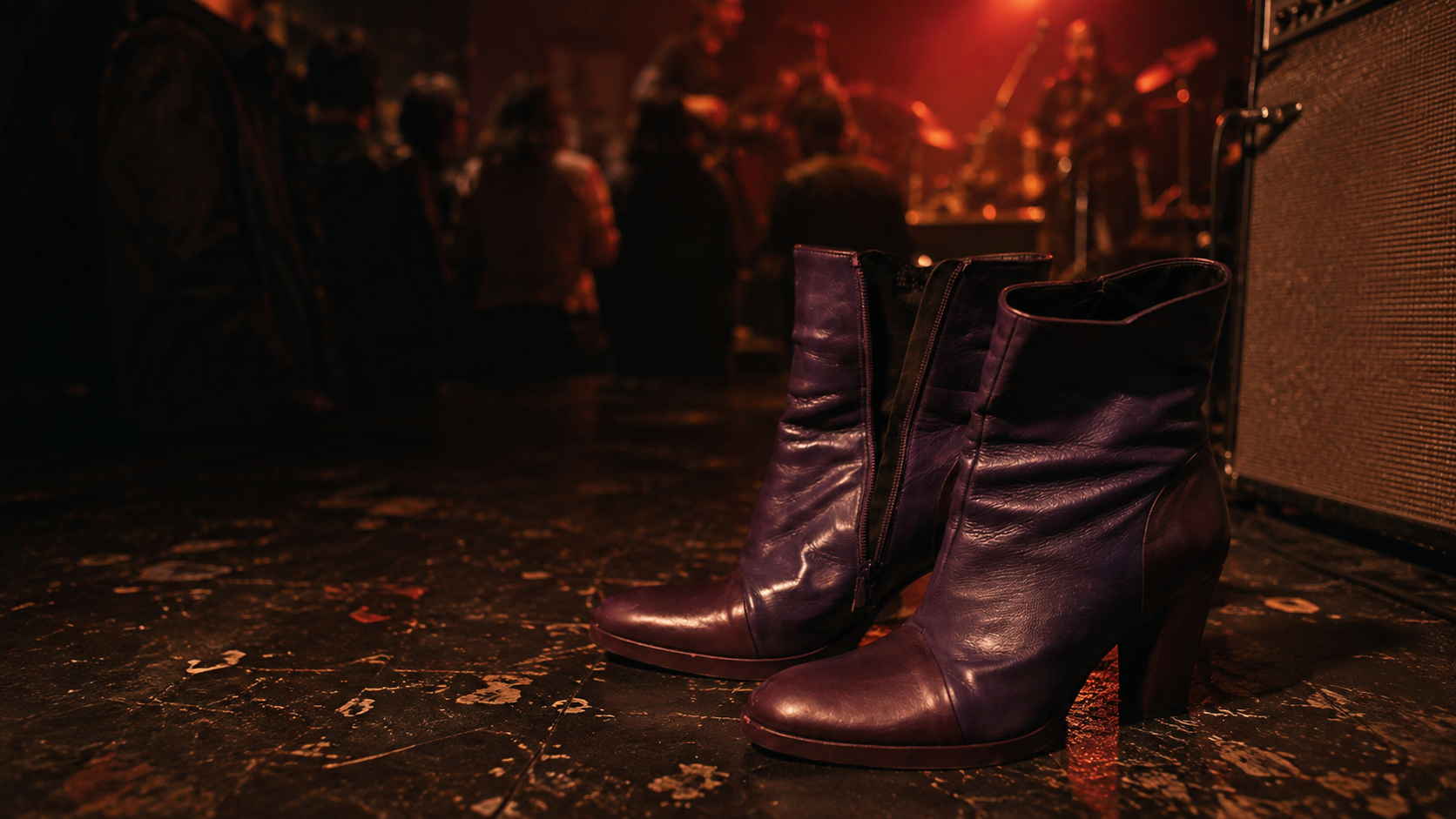
There are things you keep because they are useful, things you keep because they are beautiful, and then there are the things that have somehow slipped past every reasonable standard for continued ownership and taken up permanent residence in your life. My purple boots belonged firmly in the third category.
They were more than twenty years old, which is not necessarily ancient for a person but is quite a run for a pair of shoes that were never purchased with archival preservation in mind. Two shades of purple leather, slightly slouchy around the ankle, with a heel substantial enough to survive New York sidewalks but interesting enough that I would have bought them anyway. They had creases and scuffs and all the other evidence that appears when you wear something instead of keeping it pristine for a future resale market you could not possibly have imagined at the time.
And I had worn them. Everywhere.
I wore them all over New York, back when New York was still something I was discovering instead of somewhere I knew. They went into bars and clubs and whatever places we ended up because someone knew someone who was playing somewhere downtown. They went to see The Bastards of Melody, the band my friend Carolyn Zafiros's brother Billy played lead guitar for, which meant there were stretches of my life when following a band around from bar to bar seemed like a completely reasonable way to spend an evening.
There were leather pants involved. It was the 1990s. Nobody needs to defend this.
The boots went to CBGBs.
That fact alone has probably saved them from donation more times than I can count.
You can be standing in a bedroom decades later, holding a pair of shoes you have not worn in years, perfectly aware that they are taking up space and that you are not suddenly going to reorganize your current life around vintage purple ankle boots, and still hear yourself thinking, Yes, but these have been to CBGBs.
As arguments go, it has no practical merit whatsoever. It also worked on me for years.
When I first got to New York, I had not yet learned how quickly extraordinary things become normal. That is one of the city's tricks. At first everything feels cinematic, even the parts that are objectively terrible. You come up from the subway and there it is. You walk past some place you have heard about your entire life and people are just going inside. You meet someone at work or in a bar or through another friend, and suddenly you are in a part of the city you did not know existed two weeks earlier.
Eventually, of course, you develop opinions about train lines and grocery stores. You know which corners are impossible to cross at rush hour. You stop looking up. You learn that some legendary places are actually cramped, dirty and badly ventilated, which does not make them less legendary but does make the mythology considerably stickier.
Before any of that happens, though, there is a period when the city is still opening.
Carolyn was my first real friend in New York, and through her came Billy and The Bastards of Melody and nights that did not feel important while they were happening because why would they? They were simply our lives. Someone was playing. We went. There was another bar after that, and maybe another one after that. CBGBs was not yet a lost landmark to be invoked with reverence by people who had never been there. It was a place where we danced.
I think that distinction is part of what I was really keeping all these years.
The boots were attached to a version of New York that had not yet become the past.
That is different from nostalgia, or at least I think it is. Nostalgia tends to clean things up. It edits out the cab that never came and the terrible bathrooms and the friend who was fighting with her boyfriend and the fact that you were exhausted but stayed out anyway because you were already downtown and somebody knew about another place. It turns entire decades into a flattering montage.
I do not need the flattering montage. I remember enough of the inconvenient parts.
What I wanted, without really knowing I wanted it, was access to the feeling underneath all of that: being young enough in a city new enough to me that I did not yet know which nights, people, places and accidental decisions were going to matter.
There is an enormous freedom in not knowing the shape of your own history.
You meet someone and she is simply Carolyn. You do not know she will later become part of the story you tell about your first years in New York. Her brother is simply Billy, and his band is playing, so you go hear them. You put on purple boots because you like purple boots. You dance at CBGBs because that is what you are doing that night, not because you understand you are collecting an anecdote that will still make a pair of shoes difficult to donate more than two decades later.
Nothing announces itself when it becomes important.
That may be the part I miss most about being young, much more than youth itself. I do not particularly yearn for the uncertainty, the lack of money, the catastrophic romantic judgment or the hours spent waiting for somebody to call. I am not interested in turning my twenties into a lost golden age simply because enough time has passed to improve the lighting.
But I do miss discovering my life while I was already inside it.
The purple boots somehow became attached to that.
Which was why, when I finally decided they had to go, I did not immediately put them in the donation bag.
I put them on.
There is something inherently ridiculous about staging an emotional reunion with your younger self while walking around a bedroom in old boots, and I am grateful for that because it prevented the whole thing from becoming unbearably solemn. I was not standing in front of a mirror with a soundtrack swelling in the background. I was mostly checking whether I could still walk in them and wondering how I had once done so for hours without giving the matter much thought.
Then something stranger happened.
They felt familiar.
Not comfortable exactly, although they were not bad. Familiar in the way an old route through a city can come back before you have consciously remembered where to turn. The angle of the heel, the way my foot landed, the slightly different posture they gave me, all of it seemed to bypass the twenty-plus years in between.
For a few minutes, I remembered the feeling of wearing them when they were not old boots.
They were just my boots.
That was what got me.
Objects become sentimental because time changes around them. Nobody buys the thing already knowing which version of themselves it will eventually represent. You buy a coat because you need a coat. You pick up a coffee mug somewhere. You wear a pair of purple boots because you are going out. Then years pass, and suddenly you are holding an archaeological artifact from your own life.
For a long time, I think I believed that getting rid of the object meant surrendering some small piece of access to the person I had been while using it. The boots were physical proof that the nights had happened, that I had lived in that New York, that I had danced at CBGBs and followed a band around and walked through Battery Park and gone out in leather pants without once stopping to consider whether someday I would find any of this charmingly reckless.
Maybe that is why closets become museums so easily.
We insist we are saving the dress or the shoes or the old concert shirt, but sometimes what we are really saving is evidence.
I was here.
I did this.
I was that person.
Walking around my bedroom in the purple boots one last time made the evidence feel less necessary.
The memories were not stored in the leather. Carolyn did not disappear because I took them off. Billy and The Bastards of Melody did not become less real. CBGBs had already been gone for years, and yet I could still remember being there with a specificity that had absolutely nothing to do with whether a pair of shoes remained in my possession.
Most importantly, that young woman was not trapped inside the boots waiting for me to visit her.
She had been coming with me the whole time.
That sounds more sentimental than I mean it to, because I do not think we carry our younger selves around in some perfect, preserved form. Thank God. I have met my previous judgment and would not give all of it continued voting rights.
But there are parts that remain. The appetite for ridiculous shoes, obviously. The tendency to say yes to things because they might turn into something. The conviction that being overdressed is usually preferable to the alternative. The part of me that still believes a city is best understood by walking through it until your feet hurt.
Those things did not require storage space.
So I donated the boots.
I hesitated, because of course I did, but I put them in the bag and let them go with the rest.
And instead of feeling like I had thrown away some priceless artifact of my own history, I found myself thinking about whoever might find them next.
She will have no idea where they have been.
She will not know about Carolyn or Billy. She will not know that The Bastards of Melody once had a woman in purple boots following them around New York. She will not know that those heels crossed the floor at CBGBs or walked through a city that felt impossibly large and new to the person wearing them.
She will probably just see a pair of strange, fabulous purple boots in a thrift store and think, I could wear those.
I hope she does.
I hope she wears them somewhere loud. I hope she stays out too late. I hope someone calls with a plan that makes no sense and she goes anyway. I hope the boots collect an entirely new set of stories that have nothing to do with mine.
They had already done their job for me.
She can have the boots.
I kept New York.