I Have Become Emotionally Invested in Several Houseplants
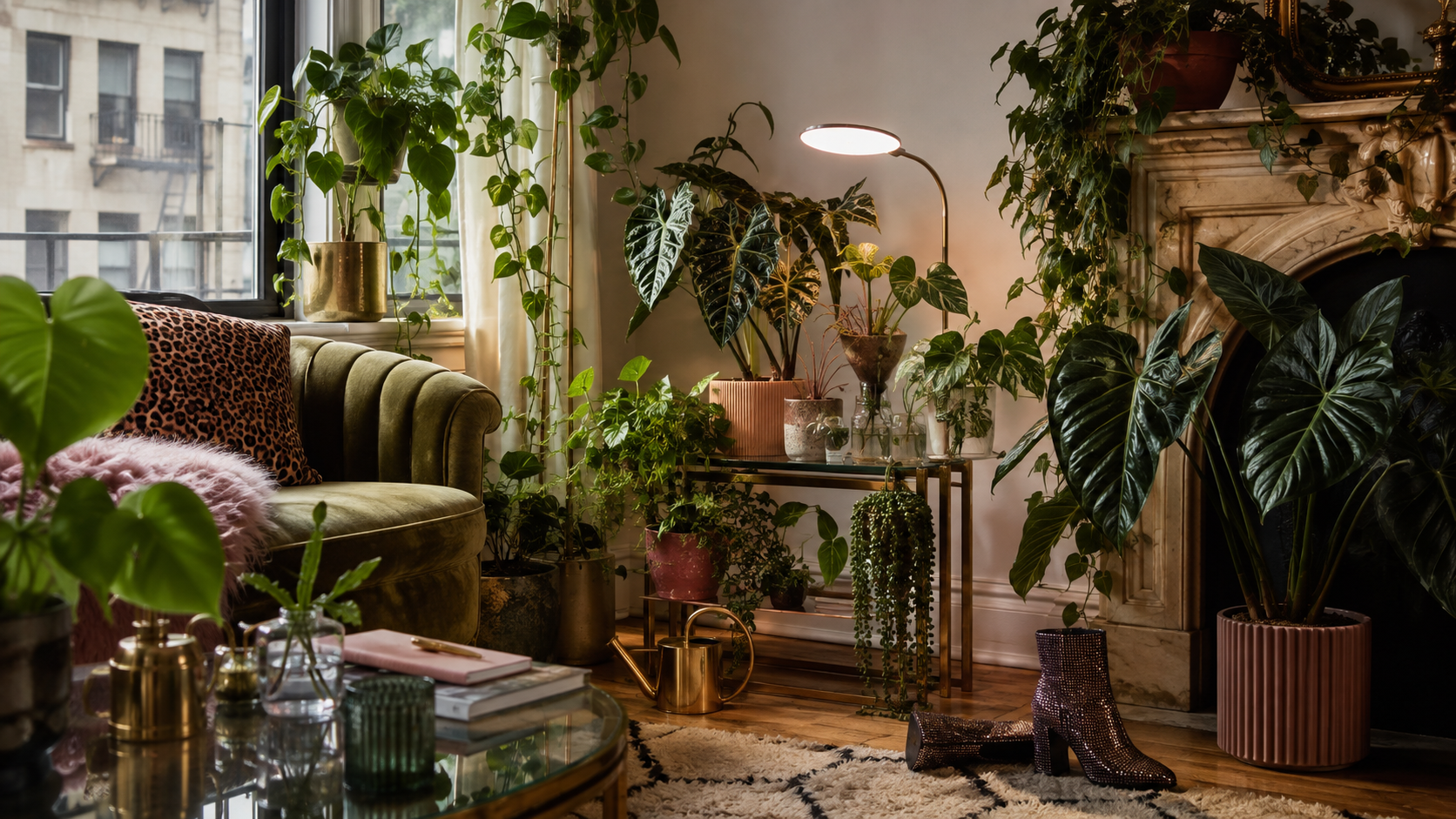
There was presumably a time when I owned plants in the normal way, although I can no longer produce evidence of it.
Normal plant ownership, as I understand it, involves buying something green, putting it near a window, watering it with reasonable frequency and occasionally noticing that it has grown. The plant remains an object in the room rather than a member of the household. It does not have a name. You do not discuss its mood. You certainly do not come home after being away for two days, look across the room and immediately realize that somebody has fainted.
Somewhere along the line, I crossed over.
There are now grow lights in my bedroom. There is distilled water specifically because certain plants apparently find tap water beneath them. Cuttings have occupied shot glasses, mason jars and whatever other vessels were available when somebody needed to be rescued or propagated. I have stood over pots containing little more than dirt and several alarming sticks, poked gently at the remaining structure and announced, with complete sincerity, that the core was still firm.
This is not how I expected adulthood to go.
I also did not expect the plants to develop personalities, although in fairness I may have assigned those myself. A plant that continues growing under ordinary household conditions is “easygoing.” A plant that collapses because I went away for forty-eight hours is “dramatic.” A plant that spends six months appearing to do absolutely nothing and then produces one leaf is suddenly the subject of a household press release.
None of this is gardening. Gardening sounds serene. Gardening involves straw hats and baskets and people who know what compost is doing at a molecular level. What I am running is closer to a small residential facility with inconsistent staffing and several tenants who refuse to communicate except through increasingly cryptic physical symptoms.
Competence Is Punished Everywhere
The plants that behave themselves get almost no attention.
This is deeply unfair but also exactly how every other institution works. If you quietly show up, perform your responsibilities and refrain from creating emergencies, congratulations: everyone assumes you’re fine and moves on to the person currently lying face-down on the carpet.
Some houseplants understand the assignment. They grow. They make leaves. They tolerate the occasional delayed watering without turning it into an extinction event. I appreciate them enormously, but my appreciation tends to take the form of walking past and saying, “You look good,” before devoting forty minutes to somebody else who has developed a brown edge.
The difficult plants have figured out that crisis is attention.
Begonias, for example, appear to have been designed by people who felt houseplant ownership had become insufficiently adversarial. They are beautiful enough to make you believe the relationship might work, then spend the rest of their lives introducing increasingly specific terms and conditions.
Too much water? Collapse.
Not enough water? Collapse.
Moved slightly? Collapse.
Stayed exactly where they were? They will consider their options and get back to you.
I have now reached the point where a plant can look objectively terrible and I will refuse to declare it dead because there is technically still something firm in the middle. This is how perfectly rational adults end up maintaining a pot of sticks for weeks because there might be a comeback underway.
The worst part is that sometimes there is.
That is how they get you.
A plant that should, by all visible evidence, be finished will suddenly produce something green. Barely anything, really. A nub. A suspicious bump. The botanical equivalent of one finger moving in the final scene of a horror movie.
And immediately all previous grievances are suspended.
Look! New growth!
Never mind that I spent the previous month threatening to put the entire pot outside and let nature make the final decision. There is now a leaf coming. We are rebuilding.
One Leaf and Suddenly There’s a Press Conference
This is the part of plant ownership nobody adequately explains: the return on investment for extremely minor developments becomes completely irrational.
A new leaf should not matter this much.
I know that.
I also know that when a plant has spent six months apparently contemplating whether participation is still aligned with its personal goals, and then finally unfurls something, it feels significant enough that other people need to be informed.
The leaf is opening.
It opened more.
No, you don’t understand, this one has been stuck forever.
There are photographs.
At some point you hear yourself talking and realize that, to an outside observer, you appear to be providing live coverage of photosynthesis.
The propagations are worse because they add suspense. You put a cutting in water and wait for something to happen, which is an objectively terrible entertainment format. Days go by. Nothing. More days go by. Still nothing. Then one afternoon there is a tiny white root, and suddenly this glass of water on the windowsill has a narrative arc.
Some of them make it into soil. Some of them decide water is where they belong now and I am not currently interested in challenging that decision. I have reached a stage in my plant education where “Is it alive?” has occasionally replaced “Is this technically the correct method?” as the governing standard.
Which brings us to the conversations.
I talk to the plants.
Not in the earnest, enriching-carbon-dioxide way people sometimes discuss talking to houseplants. I am not reading them poetry. I am mostly conducting performance reviews.
“You look amazing.”
“What happened here?”
“You were FINE yesterday.”
“I am not moving you again.”
“This is literally the window you liked.”
And, most frequently:
“I genuinely don’t know what else you want from me.”
There is a particular kind of indignity involved in saying this to a plant because the plant, naturally, offers no clarification. A dog can whine by the door. A cat can scream directly into your face. A houseplant simply deteriorates in silence and leaves you to determine whether the problem is water, light, humidity, soil, drainage, temperature, minerals, repotting, not repotting, Mercury retrograde or a private moral objection to your entire operation.
Then you change one thing, it improves, and you feel brilliant.
This is probably why the obsession becomes self-sustaining. Adult life offers very few problems that can be solved by moving something six inches to the left. Houseplants occasionally do. The world remains chaotic, the inbox is still the inbox, but somebody needed brighter indirect light and you actually had some.
There is satisfaction in that.
Unfortunately, there is also confidence.
Confidence is how you get more plants.
Once They Have Names, It’s Over
Naming them was probably where any pretense of casual ownership collapsed.
A nameless plant can be discarded with a certain emotional distance. “The plant didn’t make it” is unfortunate but manageable. Once the plant has a name, however, you have created a character, and characters develop continuity.
Now there is history.
This one survived the move. This one hates that corner. This one looked spectacular for three months and then chose violence. This one has been technically recovering for so long that “recovering” may simply be its permanent state. This one needs absolutely nothing and deserves more praise for it. This one is beautiful, difficult and fully aware that replacement would be emotionally complicated.
Before long, the plants also acquire reputations with people who do not live here.
Someone asks how a particular one is doing.
I know exactly which one they mean.
This should have been the warning.
Instead I did what any reasonable person would do after accidentally creating a cast of recurring botanical characters: I gave them their own section of a website.
This is The Real Plants of NYS, which began as a way to keep track of the collection and has somehow evolved into resident files, personalities, confessions and enough internal mythology that I can no longer convincingly claim the plants are merely décor.
In my defense, once everyone has names and complicated relationships with direct sunlight, a basic spreadsheet feels cold.
There is also something extremely funny to me about giving houseplants the level of documentation normally reserved for reality-show contestants or persons of interest. They have species names, care requirements, known behaviors and statements that may or may not be admissible later.
This is useful information.
It is also possible that I have lost perspective.
The Stakes Are Tiny. The Stakes Are Enormous.
The embarrassing truth underneath all of this is that I genuinely like taking care of them.
Not every minute of it. There are moments when a plant I have moved, watered, repotted, researched, encouraged and possibly negotiated with responds by becoming inexplicably worse, and I briefly understand why some people own nothing but one artificial orchid.
But then something grows.
A cutting roots. A leaf opens. A plant that looked finished decides otherwise. Something I moved to the right spot starts thriving, and every time it happens I get the same absurd little sense of victory.
It is not important in any grand sense. Nothing outside this room changes because one houseplant has produced a new leaf.
That may be exactly why it feels so good.
There is no strategy deck. No algorithm changed overnight. No committee needs to approve the outcome. There is just a living thing that needed something, and occasionally I manage to figure out what that something was.
Of course, sometimes I don’t.
Some plants come into your life, reject every accommodation you offer and leave behind a pot of dirt plus several hours of internet research you will never recover. This is annoying, but it has also taught me one very important lesson: I do not have to be good at every plant.
There will be no more begonias.
Probably.
The rest of them are staying, assuming they agree.
There are enough now that they have names, reputations, preferred locations and an entire page devoted to their ongoing affairs, which feels less ridiculous the longer I live with it. The page is called The Real Plants of NYS, and if you would like to know who is thriving, who is difficult, who cannot be trusted around tap water and who is currently being held together by optimism and a firm core, their resident files are available for inspection.
I could have simply made a list.
Instead I gave them dossiers.
This was easier than admitting I have become management.